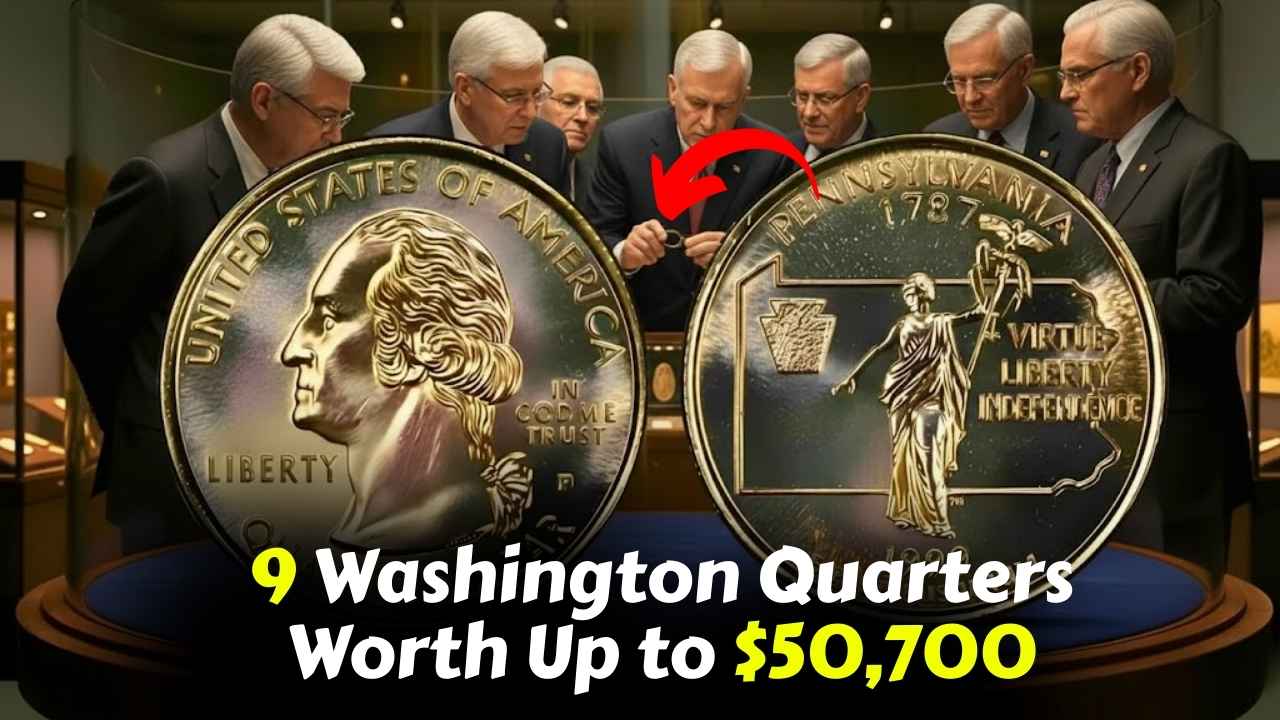
9 Most Valuable Washington Quarters: Washington quarters have been a cornerstone of U.S. coinage since 1932, introduced to honor George Washington’s 200th birthday. Over the decades, millions have circulated, but a select few possess unique features that make them extremely valuable. These rare Washington quarters, often distinguished by minting errors, low production numbers, or special finishes, can command impressive prices at auctions. Even coins that have sat unnoticed in old collections, jars, or pockets may hold surprising worth.
Rare Washington Quarters and Their Estimated Values
| Washington Quarter | Year | Key Feature | Estimated Value |
|---|---|---|---|
| 1932-D | 1932 | Low mintage Denver Mint | $25,000 – $50,700 |
| 1932-S | 1932 | Low mintage San Francisco Mint | $20,000 – $45,000 |
| 1943 Double Die Obverse | 1943 | Doubled lettering and design | $5,000 – $30,000 |
| 1950-S Over S | 1950 | Overpunched mintmark | $3,500 – $25,000 |
| 1934 Heavy Motto | 1934 | Pronounced “In God We Trust” | $2,500 – $15,000 |
| 1942-D Over D | 1942 | Second D mintmark | $4,000 – $20,000 |
| 1983 No Mintmark | 1983 | Unique strike characteristics | $500 – $5,000 |
| 1964 SMS | 1964 | Special Mint Set, satin finish | $30,000 – $50,700 |
| 1941-S | 1941 | Low mintage San Francisco | $2,000 – $12,000 |
Why Certain Washington Quarters Are Highly Valuable
The value of a Washington quarter is influenced by rarity, historical importance, minting anomalies, and condition. Quarters produced in limited numbers or featuring unusual characteristics naturally attract collector interest. Coins minted before 1965 carry intrinsic silver value, adding to their appeal. High-grade specimens that have survived in near-perfect condition are particularly desirable and often achieve premium prices.

Key Rare Washington Quarter Examples
The 1932-D Washington Quarter is among the most sought-after, with fewer than half a million produced at the Denver Mint. Collectors prize high-grade examples that can sell for tens of thousands of dollars. Similarly, the 1932-S quarter from the San Francisco Mint is notable for its scarcity and high collector demand.
Error coins such as the 1943 Double Die Obverse and the 1950-S Over S are especially coveted for their rarity and uniqueness. Variations like the 1934 Heavy Motto or the 1942-D Over D demonstrate how subtle minting differences can drastically increase a coin’s value. Even modern examples, like the 1983 no-mintmark quarter, may attract attention if they display unusual features or exceptional condition.
The 1964 Special Mint Set (SMS) Washington Quarter is a standout due to its satin finish and extremely limited production. These coins are rarely seen in circulation, making them some of the most valuable in the series.
How Condition Affects Washington Quarter Prices
Condition is critical in numismatics. Coins that are free from wear, scratches, or corrosion naturally command higher values. Professional grading services can authenticate a coin’s condition, providing assurance to buyers and enhancing market price. Even minor differences in quality can mean the difference between a few hundred dollars and tens of thousands.
Tips for Collectors
Collectors seeking valuable Washington quarters should examine mint marks, production years, and known error varieties. Magnification tools and reference guides are essential for spotting subtle variations. Proper storage in protective holders or capsules preserves coin quality, and professional grading adds credibility and potential value. Monitoring auctions and sales trends can also provide insight into which coins are increasing in demand.
Final Verdict
Rare Washington quarters are more than currency; they are historical artifacts with significant investment potential. From the 1932-D and 1932-S to the 1964 SMS and key error coins, collectors can discover coins valued as high as $50,700. Checking old collections, coin rolls, and inherited items could reveal hidden treasures that combine history, artistry, and financial value.
Disclaimer
This article is for informational purposes only and should not be considered financial or investment advice. Coin values fluctuate based on rarity, condition, and market demand. Always consult professional numismatists or certified grading services before buying, selling, or investing in rare coins.
